Class 4 shingles
Impact-resistant shingles are tested under a standard called UL 2218. Class 4, the top rating, means a sample survived being hit by a 2-inch steel ball without cracking.
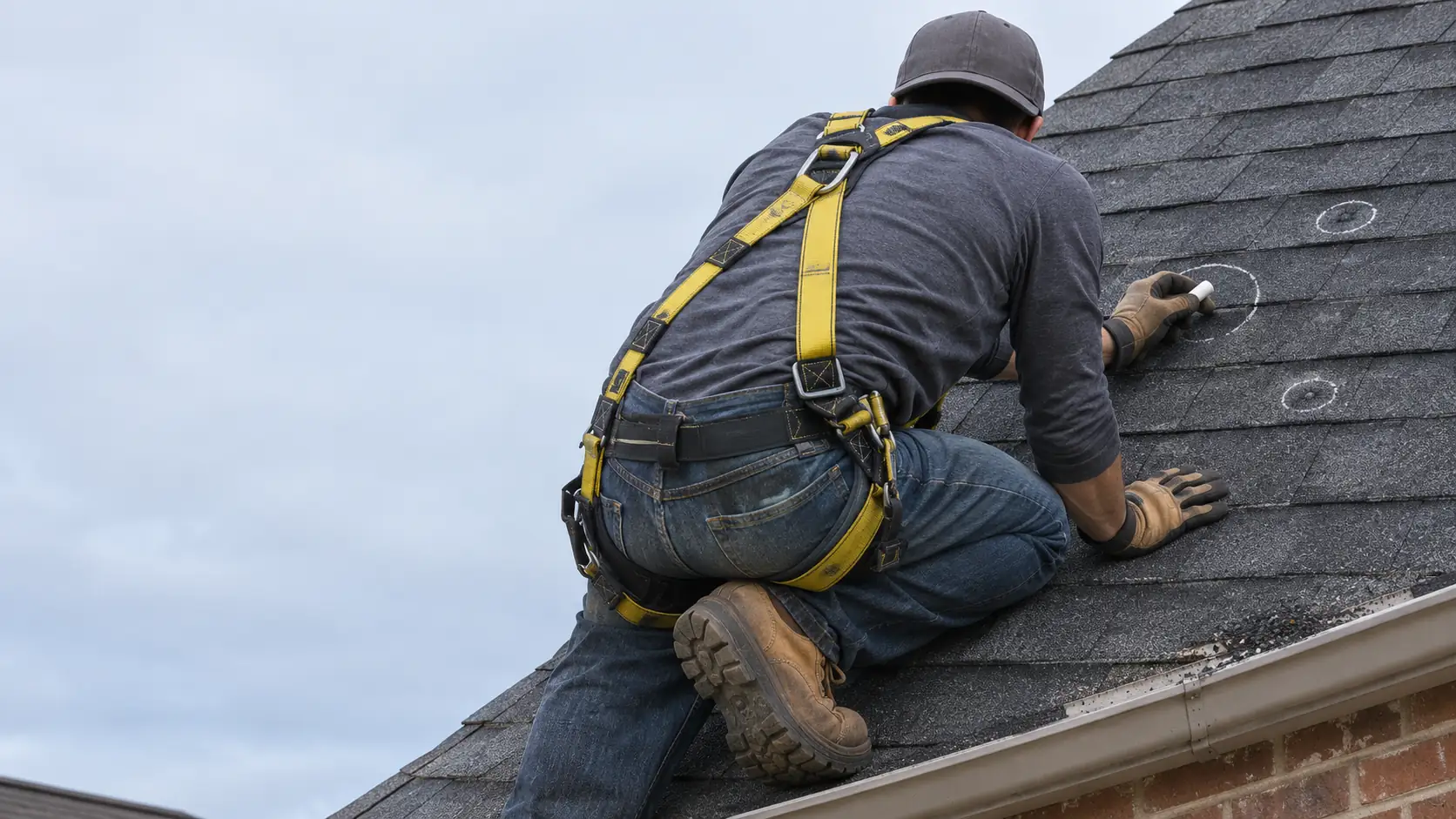
Hail damage is hard to see from the ground and often doesn't leak right away. We check your roof up close, mark every hit and repair or replace what the hail broke.
When hail hits an asphalt shingle, it knocks off the gritty granules and can bruise or crack the mat underneath. From the street, the roof may look fine. But those bruised spots age faster in the sun, and months later they start to crack and let water in.
That delay is why many homeowners don't find hail damage until a leak shows up, and by then it can be hard to show which storm caused it. Most insurance policies also set a deadline for reporting storm damage, so it pays to have the roof checked soon after a hail storm.
On the roof, we look for soft spots, circles of missing grit and cracked shingles. We mark each hit with chalk, count the hits in test areas on every slope and photograph all of it.
These signs are easy to spot once you're on the roof, and almost impossible to see from the yard.
We check each side of the roof, plus vents, gutters and flashing, and mark the hail hits.
You get clear photos and notes showing where the damage is and how much there is.
A few hits can often be repaired. Damage across most slopes usually means a new roof.
We do the work. For most replacements here, that includes the windstorm inspection.
Thinking about filing a claim? See how our insurance claim help works.
If hail has hit your roof before, it's worth looking at roofing that holds up better when it's time to replace.
Insurance tip: Right after a hail storm, take photos of the hail stones next to a coin or ruler for size, and write down the date and time. It helps if you file a claim later.
We check and repair hail-damaged roofs in Angleton and these nearby towns.
No, at least not right away. Hail often bruises shingles and knocks off their protective grit without breaking through. Those spots then wear out faster in the sun and can start leaking months later, which is why an inspection after a hail storm is worth it.
Hail about 1 inch across, roughly the size of a quarter, or bigger can damage asphalt shingles, especially older ones. Smaller hail can still cause damage when strong wind drives it into the roof or when the shingles are already worn.
If the damage is limited to a few shingles or one slope, a repair can work. When hail has bruised shingles across most of the roof, replacing it is usually the better fix, since patched areas won't match and the rest of the roof will keep failing.
As soon as you can safely do it. Fresh hail marks are easier to see and to tie to a specific storm, and most insurance policies have a deadline for reporting damage. Check your policy for the exact time limit.
Planning a claim? See what we document and the Texas rules to know.
Learn more →Not sure hail hit your roof? An inspection gives you a clear yes or no.
Learn more →Hail damage on most slopes usually means a new roof. Here's the process.
Learn more →Call us for a close-up look at your roof. We answer 24/7.